
If your asphalt driveway edge is crumbling, water, weak support, or repeated traffic near the boundary may be breaking down the pavement. The pattern of the damage can point to the cause, but a repair that lasts usually depends on checking what’s happening below the surface too. At Atlanta Paving Solutions, we work on asphalt paving and repairs across Metro Atlanta, including residential driveways.
Why is my asphalt driveway edge crumbling?
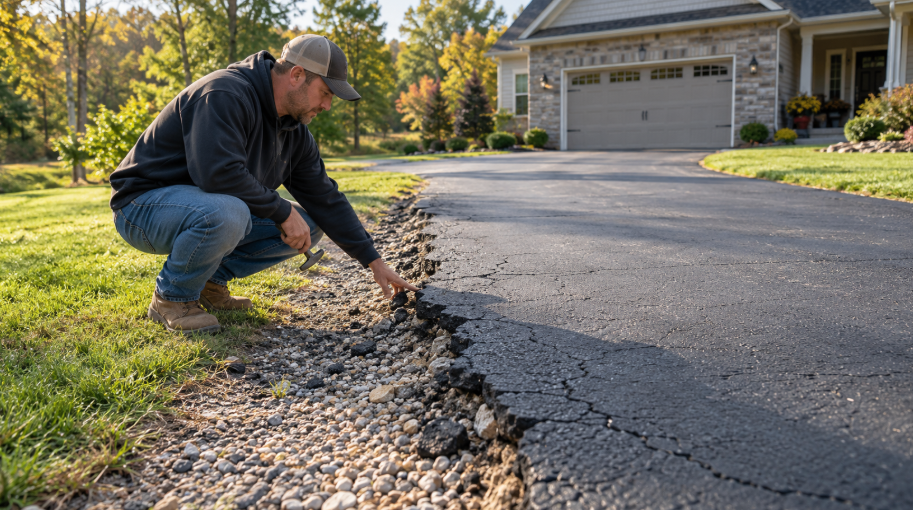
Asphalt needs firm support along its edges. When the pavement borders loose soil, an eroding shoulder, or an unsupported drop-off, the outside edge can crack and break apart under vehicle weight. Tires that repeatedly travel close to the boundary put extra stress on that strip.
Water can speed up the process. Rain running along the driveway may wash away soil or gravel beside the pavement. Water can also enter cracks and weaken the material underneath. Once the edge loses support, passing vehicles can break off pieces and make the damaged area wider.
The Federal Highway Administration’s pavement distress guide identifies edge cracking as damage along the pavement perimeter. Its guidance on edge cracking also points to factors such as weak support, settlement, and poor drainage.
Common causes of crumbling driveway edges
The pavement edge has little support
A driveway edge often meets a lawn, gravel shoulder, or sloped area. If that neighboring material sits lower than the asphalt or shifts over time, the pavement may have little support beneath its outermost strip.
This can happen when cars cut corners or park with their tires near the edge. Delivery vehicles and trailers can add stress, especially if the driveway is narrow. Look for damage concentrated where tires turn or where vehicles routinely leave the paved surface.
Water runs alongside the driveway
Watch where rainwater goes. Runoff that follows the edge can gradually erode soil or wash loose material away. A downspout that empties beside the driveway can concentrate water in one area. So can a slope that directs runoff toward the pavement instead of away from it.
Water may also collect in a low spot near the edge. If the surrounding asphalt is cracked or soft, the problem could involve the base below the surface. Our asphalt paving and repair information explains why drainage and base preparation matter to pavement performance.
The edge may have been thin or poorly supported
Asphalt edges can be more vulnerable than the middle of a driveway. If an edge has less material or the supporting base wasn’t prepared consistently, it may deteriorate sooner under traffic and weather.
You usually can’t confirm how the driveway was built just by looking at it. But a straight line of crumbling along one side, especially with little damage in the center, is a useful detail to share during an inspection.
The surface is aging
As asphalt ages, it can become brittle and more prone to cracking. Edge damage may appear first because the perimeter has less support and sees more exposure to runoff, soil movement, and tire contact.
Age alone doesn’t tell you whether the driveway needs replacement. In our article on how long an asphalt driveway lasts, we explain why base condition, drainage, traffic, and upkeep all affect the surface’s lifespan.
What does the damage pattern tell you?
A few small pieces missing from the edge may point to localized wear. A long crack running parallel to the driveway edge can suggest that the outer strip has started to separate. If the asphalt is also sinking, breaking into a web of cracks, or collecting water, the issue may go deeper than the surface.
Check whether the damage keeps returning in the same place after a patch. Repeat failures can mean that the repair addressed the visible asphalt but left weak support or a drainage issue underneath.
Take photos from the same angle every few weeks, and again after heavy rain. Note whether the damaged edge is beside a downspout, low spot, steep slope, or vehicle turning area. That information helps show how the problem is changing.
Can I fix a crumbling asphalt driveway edge myself?
A small amount of loose debris can be cleared away so you can see the edge more clearly. Avoid covering a long, crumbling section with sealcoat. Sealcoating protects the surface; it doesn’t rebuild missing asphalt or restore support beneath it.
A surface patch may also fail if water continues to wash out the shoulder or the base has weakened. Before choosing a repair, it’s useful to determine whether the damage is limited to the asphalt edge or extends into the supporting material. Keep vehicles away from a severely broken edge when possible, since tires can pull away more material.
When does a driveway edge need professional repair?
Arrange an evaluation if the damage is spreading, the asphalt feels unstable, a depression is forming beside the edge, or water keeps pooling in the same area. A contractor can assess how much of the driveway has failed and whether the repair needs to address the surface, its support, or both.
A localized repair may suit damage confined to one section when the nearby pavement and base remain stable. More widespread cracking or repeated failures may call for broader restoration. An overlay or replacement may be appropriate in some cases, but the right scope depends on the existing pavement’s condition.
At Atlanta Paving Solutions, we handle asphalt paving and repair work for residential and commercial properties across Metro Atlanta. If your driveway edge continues to break apart, contact our team to request an estimate. Share where the damage appears and whether it worsens after rain so we can evaluate the problem in context.
Keep an eye on the edge after repairs
After repairs, watch how water drains beside the driveway and whether the neighboring soil or gravel stays in place. If the same edge starts crumbling again, note the location and how quickly the damage returns. Those signs can show whether the repair held or if the support or drainage needs another look.
Focusing on the damaged area and the conditions around it helps determine whether a small repair is enough or a larger section needs attention.
